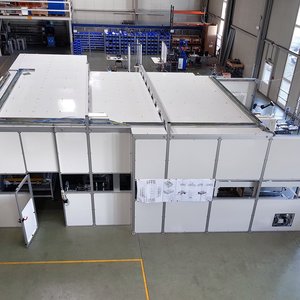
An automation specialist is developing a fully automatic testing system for camshafts for a customer in the automotive industry. Since technical cleanliness must be ensured for the measurement and checking process, the system requires an enclosed housing.
Precise Parts Handling in Accordance with Standards
The automotive industry is one of the most important industrial sectors worldwide. It is subject to strict, international standards and regulations like few other industries. At the same time, fully automated automotive production processes require absolute reliability and efficiency.
Practical examples
We draw on our talent for innovation and our many years of experience. We are a qualified partner for countless manufacturers in the automotive section, providing fully automated transport for a wide range of vehicle parts. Our industry know-how includes extensive knowledge of all applicable production equipment regulations as well as the range of possible additional options. We employ state-of-the-art technology. To meet the specific requirements of the automotive industry, we work with only high-quality motors and gearboxes from SEW EURODRIVE and Habasit conveyor belts.
mk’s references in the automotive industry include exhaust system handling, axles, aluminium rims, petrol pumps, brakes, convertible roofs, gearboxes, radiator grilles, crankshafts, bonnets, tyres, headlamps, shock absorbers, tanks and much more.

Our partner Quickmove, a manufacturer of overhead conveyor systems, needs a transfer station from an overhead conveyor to a manual workstation and back for a customer in the automotive industry. In this case, the overhead conveyor transports small load carriers (SLC) with a size of 600x400 mm and a…
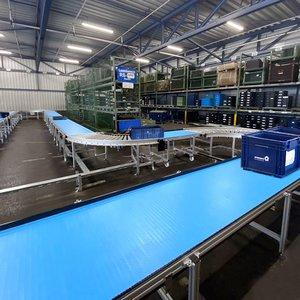
In an automotive factory, empty small load carriers are collected and cleaned at a central point, where they are then sorted according to size, type and design. A sorting line that can hold the large quantities of small load carriers and react to the different throughputs is now required.
Two test lines are required in the quality control department of an automotive supplier. The products should be checked just-in-sequence, i.e. in a fixed order.
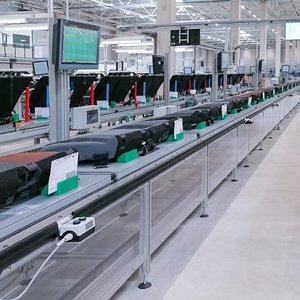
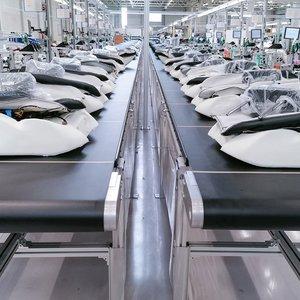
An automotive supplier is building a complete new production line for assembling seats and benches. Various production steps are required, such as feeding the upholstery and assembling the seat occupancy sensor and seat heating system.
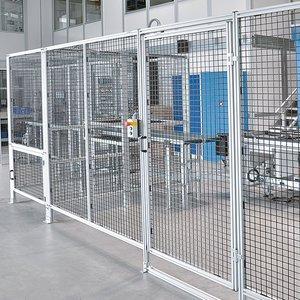
Protective machine guards are required for a fully automatic production line in the automotive industry. The plant is made up of several individual process sections, each of which is to be secured with its own protective fence.
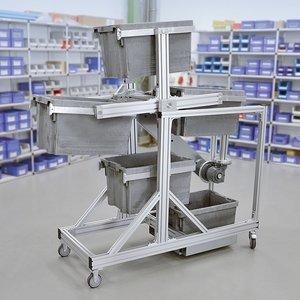
An automobile manufacturer wants to optimise the picking of orders in the manual spare parts warehouse. Therefore, a material trolley is required that is very compact and can hold up to 5 transport boxes.
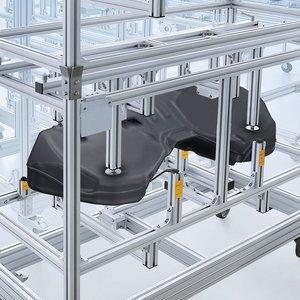
An automotive supplier requires frames in order to perform comprehensive pressure, heat and emission tests on fuel tanks and for storing these tanks. The frames are to be used to install the tanks just like in an actual vehicle. The aim is to simulate the installation situation as realistically as…
An automotive supplier required a transport system with a height-adjustable workbench that could be used to separate and test components. The workpieces were round with various diameters and were placed on the conveyor system by robots in twenty-second cycles.
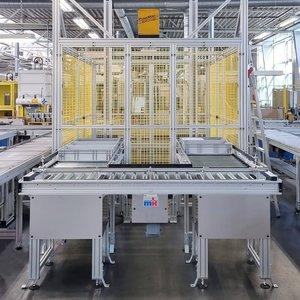
A supplier in the automotive industry requires a conveyor system for supplying and removing standardised heavy-weight plastic pallets measuring 1200 x 800 mm. The plastic boxes on these pallets contain aluminium parts to be transported into the gripping area of a robot.