


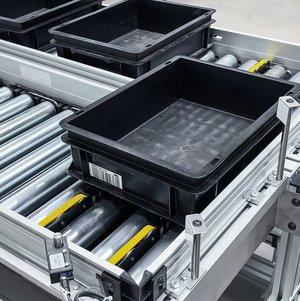
Two RBF 2000 roller conveyors perform buffering of SLCs before and after a packaging machine and, thanks to ZPA, ensure a reliable, continuous flow of materials.

The roller conveyor RBF 2000 is suitable for transporting containers, boxes and trays up to 55 kg. Straight sections with motor driven rollers, gearmotors or gravity, curves, roller conveyors for alignment, infeeds/outfeeds as well as 90° transfer and multi-transfer modules can be flexibly combined. This allows standard modules to be used to create customised solutions for goods receipt and dispatch, for picking lines or for connecting the production machine to the warehouse – whether controlled decentrally or with a higher-level PLC.
Zone-operated 24V motor driven rollers enable buffering with zero pressure accumulation (ZPA). Each zone conveys only one item – if the next zone is occupied, transport stops automatically. The system therefore operates in an energy-efficient and gentle manner.
With anodised aluminium profiles and concealed cable routing within the conveyor frame profile, the RBF 2000 is sturdy, durable and neat. A system that impresses with its design as much as with its function and integrates seamlessly into the mk modular system.
Technical data:
The roller conveyor RBF 2000 is more than just a single conveyor. Straight sections with motor driven rollers, gearmotors or gravity-driven systems, curves, roller conveyors for alignment, infeed/outfeed units, as well as 90° and multi-transfer modules can be combined to create customised solutions.
The roller conveyors feature two conveyor frame profiles made of anodised aluminium profiles, which
are perforated throughout. The upper section has hexagonal holes for roller mounting via spring-loaded axles, while the lower section has round holes for crossbeams and other accessories.
The conveyors are designed to accommodate common container types used in internal material flow and can also be customised to individual dimensions.
Depending on the length, conveyed product and speed, the motor driven roller conveyor has at least one or more motor driven rollers, each of which drives several rotating rollers. Power is transmitted from roller to roller via poly-V belts or V-ribbed belts.
Using logic and sensors (photoelectric sensors), motor driven roller conveyors operate without back pressure – also known as ZPA (zero pressure accumulation). For this purpose, the conveying path is divided into zones. Each zone has its own motor driven roller, which drives additional rollers via belt coupling. The motor driven roller controllers communicate with each other and ensure, in a decentralised manner, that only one conveyed product is present in each zone at any given time. If the following zone is already occupied, the conveyed product in the previous zone will automatically stop.
The geared roller conveyor is used for cost-effective transport over longer, continuous distances. A gearmotor, positioned approximately in the centre, drives two rollers via a pulley, which in turn drive the next rollers.
Gravity roller conveyors do not have a drive mechanism; the conveyed products are accelerated by gravity or manually. Brake rollers are available upon request.
The curve module has conical rollers (plastic cones on steel rollers) which ensures that the conveyed goods maintain their orientation even when the direction changes. Depending on the length, the conveyed product and the speed, the module is also driven by at least one or more motor driven rollers. The usable width of the downstream roller conveyor must always be at least as wide as that of the curved module.
The alignment roller conveyor is driven by one or more motor driven rollers and moves the conveyed products not only in the conveying direction, but also laterally towards the side rail by tilting the rollers. This is used for alignment in front of functional units, labelling stations, etc., or to reduce the usable width of the roller conveyor along its route.
The 45° infeed/outfeed module with staggered rolls enables conveyor flows to be merged or branched. As an infeeder, it merges two roller conveyors directly, and as an outfeeder, it branches the conveyor flow in combination with a multi-transfer module.
The multi-transfer module features rows of omnidirectional rollers arranged perpendicular to each other. It is positioned between two roller conveyors with its own conveyor frame profile. This allows conveyed products to be discharged in two different ways:
Other configurations (alignment, rotation, U-turn, etc.) can be implemented upon request.
The 90° transfer unit is used to transfer conveyed products into or out of the conveyor at a right angle. The conveyed products change their orientation during this process. The 90° transfer unit is mounted in a roller conveyor with a motor driven roller (ZPA) with a 75 mm pitch. By raising the belt drives (10 mm above the rollers), the conveyed products can be moved perpendicular to their original conveying direction.
Various layouts, such as L-, T-, or cross-shaped, are possible. A 90° transfer unit on each of the parallel tracks enables goods to be transferred between the tracks. The 90° transfer unit is selected to match the conveyor width and the conveyed products. The number and arrangement of the belt guides allow for adaptation to different base dimensions of the conveyed products. The standard modules are optimised for standardised containers and carriers.
The gravity roller conveyor RBS-P 2065/66 complements the roller conveyor portfolio with 20 mm or 40 mm diameter rollers for transporting smaller and lighter goods. The RBS-P 2065/2066 is ideally suited for semi-automated linking systems, such as at picking stations or in Kanban racks, and can be flexibly adapted with modular extensions like side rails or stands.
Two RBF 2000 roller conveyors perform buffering of SLCs before and after a packaging machine and, thanks to ZPA, ensure a reliable, continuous flow of materials.

A manufacturer of office supplies needed a conveyor line for carton blanks with an integrated buffer function. The cardboard stacks come out of a cutting system in various formats and at a rate of 6 stacks per minute. The downstream stack magazine can process 4 stacks per minute, which means that a…

A manufacturer of shock absorber technology was looking for an efficient and reliable solution to automatically feed industrial shock absorbers to a robot cell. The aim was to feed the shock absorbers in cycles, securely fix them and make them available in indexed form.
This text contains the most important questions and answers concerning the belt conveyor. If you do not find the answer to your question, please do not hesitate to contact us.
The RBF 2000 is a modular roller conveyor system for container handling. It transports standardised conveyed products with a dimensionally stable base, such as cartons, boxes, containers (KLT, Euro boxes, trays), and is designed for conveyed products weighing up to 55 kg. Typical base dimensions are 400 x 300 mm and 600 x 400 mm.
The RBF 2000 is a modular roller conveyor system for container handling. It transports standardised conveyed products with a dimensionally stable base, such as cartons, boxes, containers (KLT, Euro boxes, trays), and is designed for conveyed products weighing up to 55 kg. Typical base dimensions are 400 x 300 mm and 600 x 400 mm.
The RBF 2000 roller conveyor system offers the following modules:
The RBF 2000 roller conveyor system offers the following modules:
The usable width of a roller conveyor is determined by the width of the conveyed product plus 20 mm. Standard usable widths are 320, 400, 420, 500, 620 and 700 mm. Custom widths are available.
The usable width of a roller conveyor is determined by the width of the conveyed product plus 20 mm. Standard usable widths are 320, 400, 420, 500, 620 and 700 mm. Custom widths are available.
The RBF 2000 roller conveyor system is available with pitches of 75, 100 and 175 mm. The pitch should be selected so that there are always at least three rollers beneath the conveyed product. The more rollers there are beneath the conveyed product, the smoother the run.
For plastic boxes, it is the actual contact area that counts, not the overall dimensions.
A single section of an RBF 2000 system can be up to 6 m long (using continuous aluminium profiles). Individual conveyors can be linked together without restriction.
A single section of an RBF 2000 system can be up to 6 m long (using continuous aluminium profiles). Individual conveyors can be linked together without restriction.
The RBF 2000 roller conveyor system offers three drive principles:
The RBF 2000 roller conveyor system offers three drive principles:
The RBF 2000 roller conveyor system uses the PULSROLLER Senergy-Ai 24 V motor-driven roller as standard: a 50 mm motor-driven roller with a brushless three-phase motor (BLDC), 50 W mechanical power and a 24 V DC supply.
The RBF 2000 roller conveyor system uses the PULSROLLER Senergy-Ai 24 V motor-driven roller as standard: a 50 mm motor-driven roller with a brushless three-phase motor (BLDC), 50 W mechanical power and a 24 V DC supply.
The RBF 2000 roller conveyor system uses a 50 mm roller with a 1.5 mm galvanised steel tube as standard. Stainless steel tubes as well as PVC and PU coatings are available on request. The shaft is a hexagonal spring-loaded shaft (12 mm) for quick, tool-free roller replacement.
The RBF 2000 roller conveyor system uses a 50 mm roller with a 1.5 mm galvanised steel tube as standard. Stainless steel tubes as well as PVC and PU coatings are available on request. The shaft is a hexagonal spring-loaded shaft (12 mm) for quick, tool-free roller replacement.
The RBF 2000 roller conveyor is suitable for transporting conveyed products of up to 55 kg per product.
The RBF 2000 roller conveyor is suitable for transporting conveyed products of up to 55 kg per product.
In a line of an RBF 2000 roller conveyor divided into zones, each zone has its own drive and its own sensors. The zones communicate with one another. Advantage: energy efficiency, as only the necessary zones are in operation.
In a line of an RBF 2000 roller conveyor divided into zones, each zone has its own drive and its own sensors. The zones communicate with one another. Advantage: energy efficiency, as only the necessary zones are in operation.
The curve module for the RBF 2000 roller conveyor system is available in the following versions:
The curve module for the RBF 2000 roller conveyor system is available in the following versions:
For the RBF 2000 roller conveyor system, there are three types of uprights based on a standardised system for straight sections, curves and inclines:
For the RBF 2000 roller conveyor system, there are three types of uprights based on a standardised system for straight sections, curves and inclines:
For custom requests, please contact our technical sales department at info(at)mk-group.com, by phone at +49 2284598-0 or using the contact form below.